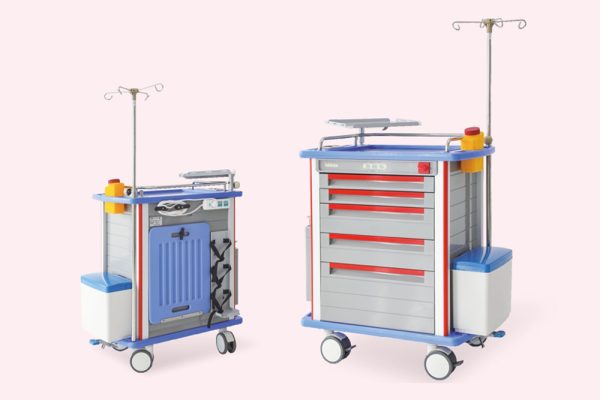
Medical trolleys are far from simple utility carts. In modern healthcare settings, they function as specialized mobile workstations, each engineered for a distinct clinical workflow – from life‑saving emergency response to routine medication distribution and infection containment. Understanding their clinical classification and technical specifications is essential for optimising departmental efficiency, patient safety, and regulatory compliance.
This guide provides a comprehensive, evidence‑based classification of medical trolleys, detailing engineering standards, material requirements, infection control features, and caster mobility criteria, with specific references to Joyhann’s product portfolio.
Industry classification systems identify seven primary types of medical trolleys, each with unique design requirements and regulatory considerations.
| Trolley Type | Primary Clinical Setting | Core Function | Key Design Features |
|---|---|---|---|
| Emergency / Crash Trolley | ER, ICU, general wards | Cardiopulmonary resuscitation (CPR) and acute emergency intervention | Defibrillator top shelf; breakable seal lock; oxygen cylinder mount; multiple drawers |
| Anesthesia Trolley | Operating Room (OR) | Storage of anesthetic agents and airway management equipment | Lockable controlled substance compartments; removable dividers; slide-out work surface |
| Medication Delivery Trolley | General wards, long-term care | Secure distribution of oral/injectable medications | Lockable drawer system; patient-specific compartments; tamper-evident design |
| Treatment / Procedure Trolley | Bedside, outpatient clinics | Carrying sterile supplies for wound care, injections, minor procedures | Flat shelves for sterile trays; waste basin; smooth wipe-clean surfaces |
| Isolation / PPE Trolley | Isolation rooms, airborne precaution units | Centralised storage of personal protective equipment | Clear signage; outside-room placement; easily cleanable surfaces |
| Utility / Supply Trolley | Multiple departments | Transport of linens, lab samples, food, general supplies | Open shelving; colour-coded for clean/dirty segregation; quiet casters |
| IV Pole / Infusion Trolley | Wards, infusion centers | Integrated IV pole for concurrent transport of infusion pumps | Built-in IV pole; cord management; lockable drawers for infusion sets |
The emergency or crash trolley is the most critical type of medical trolley, designed to carry all necessary equipment for life‑threatening emergencies. International standards specify rigorous requirements.
| Parameter | Requirement / Standard | Source / Basis |
|---|---|---|
| Construction materials | ABS plastic, aluminum, and stainless steel | DHA Crash Cart Standards (2024–2029) |
| Minimum caster diameter | ≥100 mm; at least two casters with brakes, anti-static | DHA Appendix 4 |
| Top work surface | Stainless steel for chemical resistance and cleanability | DHA Standard Specifications |
| Defibrillator provision | Dedicated top-shelf space; movable/detachable power socket | SAIKANG Medical |
| Oxygen cylinder management | Vertical support bin with chain retention; daily flow meter check | DHA Appendix 4 |
| Break-seal mechanism | Tamper-evident lock to verify cart integrity before emergency use | Industry standard |
| Paediatric configuration | Specialized paediatric emergency kit (airways, LMAs, ETTs, cannulas) | DHA Appendix 5 |
| Regulatory compliance | ISO-14001, ISO-18001, CE, FDA, Russian Federal Registration, Brazil ANVISA | SAIKANG Medical (SKR054-ET) |
During the 2025–2034 forecast period, crash cart configurations are increasingly adopting modular drawer systems with RFID medication tracking and automated replenishment workflows.
Anesthesia trolleys function as mobile workstations for anesthesiologists during surgical procedures. They must comply with ISO 80601‑2‑13:2022 (Particular requirements for basic safety and essential performance of an anaesthetic workstation).
| Feature | Technical Specification | Clinical Rationale |
|---|---|---|
| Drawer configuration | Multiple drawer heights (3-inch, 6-inch, 10-inch) | Separates syringes, laryngoscopes, endotracheal tubes |
| Locking systems | Keyless entry with Auto-Relock; secondary proximity access | Compliance with controlled substance regulations (Schedule II–V must be locked when not under direct control) |
| Drawer guide system | Anti-open mechanism preventing accidental ajar | Prevents unattended open drawer liability |
| Work surface | Expansive top area with optional slide-out extension | Space for preparing anesthetic agents |
| Caster configuration | Four dual-locking swivel casters meeting IEC 60601-1 stability | Safe transport over uneven OR floors |
For controlled substance security, regulatory bodies require that all Schedule II through V medications be kept in locked enclosed areas when not under the direct control of an anesthesia professional. Anesthesia carts with electronic access control and audit trail functionality are increasingly mandated.
Medication delivery trolleys significantly reduce nursing workload by ensuring safe, organized distribution of patients’ daily medications.
| Design Feature | Technical Specification | Regulatory/Clinical Requirement |
|---|---|---|
| Locking mechanism | Lockable drawer system; electronically controlled access with audit trail | Must be securely locked at all times when unattended |
| Patient-specific compartments | Labeled drawers or bins by room number/patient name | Supports “Five Rights” of medication administration |
| Controlled substance management | Separate double-lock compartment for Schedule II–IV drugs | Inventory reconciliation and witnessed sign-off required |
| Caster configuration | Four-caster with two-brake or three-locking configuration; IEC 60601-1 compliant | Prevents sliding on inclined surfaces (failure threshold >50 mm slip) |
| Cleanability | Smooth, crevice-free surfaces; rounded corners; antimicrobial additive | Supports daily disinfection with hypochlorite, QAC, or peracetic acid |
Joyhann offering: The 011109 (40-slot, low) and 011109A (40-slot, high) aluminum-plastic medicine delivery carts are designed for daily ward medication distribution, with lockable drawer systems and compartmentalized storage.
| Product Code | Description | Dimensions (mm) |
|---|---|---|
| 011109 | 40-slot medicine delivery cart (low) | 750 × 520 × 940 |
| 011109A | 40-slot medicine delivery cart (high) | 750 × 520 × 1,010 |
Treatment trolleys – also known as procedure or dressing trolleys – are designed to carry supplies for wound care, minor surgical procedures, and diagnostic interventions.
| Design Requirement | Specification | Justification |
|---|---|---|
| Work surface | Flat, raised-edge top surface | Prevents instrument roll-off; supports sterile tray |
| Shelving | One to three open shelves | For sterile supplies (gauze, dressings, instruments) |
| Waste Management | Removable basin or bucket | For used dressings and contaminated materials |
| Material | ABS plastic or 304-grade stainless steel | Hypochlorite- and QAC-resistant; non-porous |
| Casters | Silent, dual-swivel, two locking | Patient-room quiet operation; stability during use |
For facilities with high infection control requirements, treatment trolleys with electropolished stainless steel create a microscopically smooth surface free of pits or grooves that could harbour germs.
Joyhann offering: The 010637, 010638, and 010638A aluminum steel treatment trolleys are suitable for bedside procedures and general clinical use.
| Product Code | Configuration | Material |
|---|---|---|
| 010637 | Treatment trolley (Type A) | Aluminum steel |
| 010638 | Treatment trolley (Type B) | Aluminum steel |
| 010638A | Treatment trolley (Type C) | Aluminum steel |
Isolation carts consolidate all necessary personal protective equipment (PPE) – gowns, gloves, masks, N95 respirators, eye protection, and hand hygiene supplies – into a single mobile hub.
| Design Principle | Technical Implementation | Infection Control Rationale |
|---|---|---|
| Point-of-care placement | Cart positioned outside patient room or just inside anteroom | Allows immediate donning before patient entry |
| Signage | Clear, multilingual signage indicating required PPE level (Contact, Droplet, Airborne) | Prevents precaution mismatches |
| Material cleanability | Smooth, crevice-free polymer surfaces; rounded corners | Supports EPA-registered disinfectant application |
| Inventory management | Organized compartments; visual inventory indicators | Reduces time searching for PPE; prevents stock-outs |
| Antimicrobial protection | Optional Microban® or silver-ion additive | Keeps cart cleaner between cleaning cycles |
Fraser Health Authority guidelines specify that one isolation cart may serve up to three or four rooms depending on site layout, with wall-mounted PPE holders recommended for narrow hallways.
Utility trolleys are the “workhorses” of hospital logistics, designed for transporting clean linens, food trays, medical records, laboratory samples, and general supplies.
| Application | Key Design Feature | Example |
|---|---|---|
| Linen transport | Open shelving or canvas bins; colour-coded for clean/soiled segregation | White for clean linens; red for soiled |
| Laboratory sample transport | Compartmentalised, lidded storage; leak-proof bins | Sample integrity; spill containment |
| Central supply distribution | Heavy-duty construction; high load capacity | Moving bulk supplies from central sterilising to wards |
| Food service | Enclosed design; temperature retention | Insulated compartments for hot/cold tray separation |
Utility carts with corrosion-proof polymer materials, smooth rounded corners, and antimicrobial protection (e.g., Microban®) are preferred for infection control.
Joyhann offering: The 010610 ABS treatment trolley with ABS top surface can serve multi-purpose utility functions.
| Product Code | Description | Top Material |
|---|---|---|
| 010610 | ABS treatment trolley | ABS plastic |
IV pole‑integrated medical trolleys serve dual purposes: standard transport unit and IV therapy support. These are particularly valuable in departments with limited space.
| Feature | Technical Specification |
|---|---|
| Integrated IV pole | Height-adjustable (1,200–2,200 mm); 4–6 hooks |
| Cord management | Cable wraps or channels to organise infusion pump lines |
| Base stability | Wider wheelbase (5-caster or 6-caster configuration) to prevent tipping with heavy infusion pumps |
| Lockable drawers | For storing infusion sets, IV catheters, and dressing supplies |
Regardless of clinical classification, all medical trolleys must meet fundamental cleanability requirements.
| Requirement | Specification | Regulatory Source |
|---|---|---|
| Smooth, easily cleanable materials | Impervious to liquids; withstand hot water and chemical disinfectants | Virginia Administrative Code 9VAC20-121-130 |
| Seam / crevice minimisation | Seamless surfaces; rounded corners; fewer joints | HUI Medical Design Standards |
| Disinfectant compatibility | Hypochlorite (500 ppm), QAC (400 ppm), phenolic (500 ppm), peracetic acid | EPA / Virginia Regulated Medical Waste Guidelines |
| Post-use decontamination | Immediate cleaning after each use when cart contacts blood or other potentially infectious materials | 9VAC20-121-130 F |
| Antimicrobial protection (optional) | Silver-ion or Microban® additive in polymer components | Maintains reduced bioburden between cycles |
Caster configuration is a critical safety feature for all medical trolleys. Under IEC 60601‑1 3rd edition caster testing protocols, medical carts are tested on inclined surfaces (5° for transport position; 10° for non‑transport position). A cart that slides more than 50 mm during testing fails the safety standard.
| Caster Configuration | Stability Performance | Typical Application |
|---|---|---|
| Two locking casters (traditional) | Frequently fails IEC 60601-1 tests | Being phased out; not recommended |
| Three locking casters | Passes testing; braking at both front and rear regardless of orientation | Medication and treatment trolleys |
| Four locking casters | Superior stability across all worst-case incline scenarios | Crash carts and anesthesia carts |
| Diagonal locking configuration | At least one locked caster resists in any orientation | General utility carts |
Wheel material and size also affect stability – larger wheels (≥100 mm) made from quality polyurethane typically perform better on slopes. Joyhann’s medical trolleys are equipped with medical-grade casters designed for silent operation and compliance with applicable caster testing requirements.
The table below summarises Joyhann’s medical trolley offerings mapped to clinical categories.
| Joyhann Product Code | Model / Description | Clinical Category | Key Specifications |
|---|---|---|---|
| 011109 | Al-plastic medicine cart (40-slot, low) | Medication Delivery | 750×520×940 mm; lockable drawers |
| 011109A | Al-plastic medicine cart (40-slot, high) | Medication Delivery | 750×520×1,010 mm; lockable drawers |
| 010637 | Al steel treatment trolley (Type A) | Treatment / Procedure | Multi-tray design |
| 010638 | Al steel treatment trolley (Type B) | Treatment / Procedure | Alternative drawer/shelf layout |
| 010638A | Al steel treatment trolley (Type C) | Treatment / Procedure | Third configuration variant |
| 010610 | ABS treatment trolley | Utility / Multi-purpose | ABS top surface |
| 011203 | Al-plastic emergency trolley (high, 5 drawers) | Emergency / Crash (basic) | 850×520×1,010 mm; 5 drawers; waste bin |
| 011203A | Al-plastic emergency trolley (low, 4 drawers) | Emergency / Crash (basic) | 850×520×940 mm; 4 drawers |
Note: For advanced crash carts (with defibrillator shelf, oxygen cylinder mount, and break-seal lock), Joyhann can provide custom configurations upon request.
Joyhann offers engineering support services specifically for trolley procurement and integration.
| Service | Technical Content | Deliverable |
|---|---|---|
| Trolley-to-ward mapping | Analysis of workflow, drawer layout, and caster flooring compatibility | Recommended trolley type per unit |
| Disinfectant compatibility testing | Test your disinfectants against Joyhann trolley materials | Compatibility chart; max exposure time |
| Caster floor assessment | Floor type analysis (epoxy, vinyl, anti-static) | Caster durometer and tread recommendation |
| Regulatory documentation | IEC 60601-1 caster test compliance and material certificates | PDF dossier |
| Remote support | Video-guided troubleshooting and spare part identification | 2-hour response (Asia-Pacific) |
How to access: Submit a request via qa@jwyuhan.com specifying “Trolley Engineering Support”.
Medical trolleys are essential mobile workstations that directly impact clinical efficiency, medication safety, and infection control. Understanding the clinical classification (emergency, anesthesia, medication delivery, treatment, isolation, utility, IV), engineering standards (IEC 60601‑1 caster testing, ISO 80601‑2‑13 for anesthesia), and cleanability requirements (smooth surfaces, disinfectant compatibility) enables evidence‑based procurement.
Joyhann’s trolley portfolio – from medication delivery carts (011109, 011109A) to treatment trolleys (010637, 010638, 010638A) and utility trolleys (010610) – is manufactured with the same precision and infection‑control focus as our medical beds. For facilities seeking to optimise ward logistics, Joyhann provides technical engineering support to match trolley specifications to clinical workflows.
Tags:
Medical trolleys
For decades, the standard approach to steam sterilizer construction has relied on a fully welded external jacket enveloping the sterilization chamber—a design intended to provide both structural reinforcement and thermal uniformity. Steam circulates within this jacket, heating the inner chamber indirectly while simultaneously serving a
Subscribe to receive exclusive insights and priority updates from Joyhann. Elevate your practice with our curated intelligence.
© Nortek HealthCare Group Ltd., 2009-2026. All rights reserved.
This site operates under the laws of the People's Republic of China. Your access and use constitute acceptance of these Terms of Use and our Privacy Policy. All content is governed by our Privacy Notice. For details or inquiries, please Contact Us or use the site's search function.