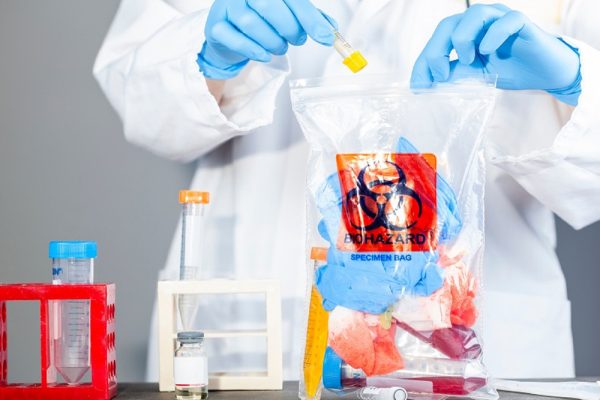
For decades, incineration has been the predominant method for treating infectious medical waste worldwide. While its high-temperature combustion effectively reduces waste volume by 95–96% and rapidly inactivates pathogens, it generates unintended byproducts that pose serious environmental and public health risks—most notably, polychlorinated dibenzo‑p‑dioxins and dibenzofurans (PCDD/Fs), collectively known as dioxins.
Why Medical Waste Is Particularly Problematic. Dioxins form when chlorine, carbon, and oxygen are present within a specific temperature range of 300–500°C. The primary chamber of an incinerator typically operates above 850°C, but flue gases passing through the cooling zone enter this critical temperature window, where dioxins form readily [16†L22-L27]. Medical waste is uniquely challenging because it contains abundant chlorine sources: PVC plastics from IV bags, tubing, and syringes serve as a primary organic chlorine source, while chlorinated disinfectants and saline residues further contribute to the problem.
Health and Environmental Impacts. Dioxins are among the most toxic compounds known to science. The World Health Organization has classified them as persistent organic pollutants (POPs) under the Stockholm Convention—colorless, odorless, and highly toxic even at trace levels. They cause cancer, reproductive and developmental disorders, and immune system damage. They remain in the environment for years without degradation, bioaccumulate in the food chain, and disperse through atmospheric and waterborne transport, contaminating regions far from the emission source.
| Impact Category | Key Characteristics |
|---|---|
| Toxicity | Extremely toxic at trace levels; WHO classifies as POPs under Stockholm Convention |
| Persistence | Remain in environment for years to thousands of years without degradation |
| Bioaccumulation | Accumulate in animal fats; enter human food chain via meat and dairy products |
| Global transport | Disperse via air and water; contaminate regions far from emission source |
| Health effects | Carcinogenic; cause reproductive, developmental, and immune system disorders |
Regulatory Response. Recognizing these risks, international authorities have established stringent standards. The European Union‘s Industrial Emissions Directive sets dioxin emission limits at 0.1 ng TEQ/Nm³, with secondary combustion chambers required to maintain temperatures exceeding 1100°C for a minimum of 2 seconds for complete oxidation of dioxins and other persistent organic pollutants [16†L29-L33][15†L4-L8]. In China, the national standard for medical waste incineration is 0.5 ng TEQ/Nm³, while stricter local standards (e.g., Hebei Province‘s 0.1 ng TEQ/Nm³) reflect a clear trend toward tighter limits [5†L36-L37].
Despite these standards, real-world enforcement reveals persistent violations. In Guangdong Province, an incineration facility was found with dioxin emissions of 53.5 ng TEQ/m³—exceeding the national standard limit by a factor of 106 times. Similarly, a medical waste incinerator in northwest China recorded flue gas dioxin concentrations averaging 184 ng TEQ/m³—368 times the national limit. These violations result in soil and air contamination that persists for decades.
China has established a comprehensive regulatory framework for medical waste management, covering both incineration and non-incineration technologies.
National Standards for Non-Incineration Technologies.
| Standard | Title | Applicability |
|---|---|---|
| HJ/T 276-2006 | Technical Specifications for Centralized Medical Waste Treatment by High-Temperature Steam | Centralized high-temperature steam treatment facilities; may be referenced for on-site treatment in areas without centralized facilities [8⁺L14-L16] |
| HJ/T 228-2006 | Technical Specifications for Centralized Medical Waste Treatment by Chemical Disinfection | Chemical disinfection of infectious waste; applicable to centralized treatment facilities [9⁺L10-L11] |
| HJ/T 229-2006 | Technical Specifications for Centralized Medical Waste Treatment by Microwave Disinfection | Microwave disinfection of infectious waste; applicable to centralized treatment facilities [9⁺L10-L12] |
These standards specify that high-temperature steam treatment is applicable to infectious waste and injury-related waste from the Medical Waste Classification Catalog, but not to pathological waste, pharmaceutical waste, chemical waste, or waste containing mercury or high concentrations of volatile organic compounds [8†L17-L18].
Regulatory Status of Treated Waste. Under the National Hazardous Waste List (2025 Edition), infectious waste (waste code 831-001-01) and sharps waste (waste code 831-002-01) remain classified as hazardous waste even after treatment with HJ/T 276-2006, HJ/T 228-2006, or HJ/T 229-2006 [9†L8-L12][10†L4-L8]. However, the disposal process—landfilling or incineration of the treated waste—is exempt from hazardous waste management requirements when the treated waste enters a municipal solid waste landfill or municipal solid waste incinerator [9†L12].
Policy Support for On-Site Treatment. The 2025 Guidance on Further Strengthening Hazardous Waste Environmental Governance and Strictly Preventing Environmental Risks (环固体〔2025〕10号), issued by the Ministry of Ecology and Environment, explicitly calls for improving medical waste collection and disposal systems and optimizing disposal methods for remote areas [14†L4-L7]. The guidance promotes establishing on-site treatment facilities where centralized disposal is not feasible, creating a clear policy opening for distributed, non-incineration technologies.
The National Health Commission‘s response to the 14th National People‘s Congress further notes that medical waste disposal regulations explicitly permit on-site disposal where centralized conditions are unavailable, and that the integration of new technologies and methods for medical waste disposal should be further advanced [13†L15-L18].
The following comparative tables summarize the key technical, environmental, and economic differences between incineration and high-temperature steam sterilization.
Table 1: Technical Performance Comparison
| Parameter | Medical Waste Incineration | High-Temperature Steam Sterilization w/ Integrated Shredding |
|---|---|---|
| Treatment mechanism | High-temperature combustion (850–1200°C) | Saturated steam under pressure (134°C, 45 min) |
| Pathogen inactivation efficiency | ≥99.9999% (at proper operating conditions) | ≥99.9999% (validated 6-log reduction) |
| Volume reduction | 95–96% | Approximately 80% |
| Shredding integration | Not required; waste combusted as received | Required for optimal efficacy (exposes all surfaces to steam) |
| Secondary combustion requirement | Required (≥1100°C / ≥2 sec) to minimize dioxins | Not applicable |
| Dioxin and furan formation | Inherent byproduct of combustion with chlorine sources | Zero—no combustion, no dioxin formation |
| Flue gas treatment | Required (quench tower, acid gas scrubber, activated carbon injection, baghouse filters) | Condensation + filtration for process vapors |
Table 2: Emission Profile Comparison
| Emission Category | Incineration | High-Temperature Steam Sterilization w/ Integrated Shredding |
|---|---|---|
| Dioxins/furans (PCDD/F) | Present as inherent byproduct; compliance depends on secondary combustion and flue gas treatment [16⁺L34-L37] | None—no combustion pathway for dioxin formation |
| Particulate matter | Present; requires baghouse filtration | Minimal; only from shredding operation |
| Heavy metals | Present in flue gas and ash | None |
| VOCs | Present; requires afterburner or oxidation | Low (45.72 mg/m³ for autoclaves) [17⁺L33-L35] |
| Ammonia (NH₃) | Present in flue gas | Low (2.58 mg/m³) [17⁺L33-L35] |
| CO₂ emissions | High (combustion of waste + transport) | Low (5× less than incineration) [18⁺L32-L33] |
| Liquid effluent | Scrubber wastewater requiring treatment | Thermally disinfected prior to sewer discharge |
| Solid residue | Toxic ash requiring hazardous waste landfill | Non-infectious residue; landfill as general waste |
Table 3: Operational and Facility Requirements
| Parameter | Incineration | High-Temperature Steam Sterilization w/ Integrated Shredding |
|---|---|---|
| Fuel requirements | Fuel oil or gas for startup and support | Saturated steam (electric or facility steam) |
| Utility requirements | High: electricity, water for cooling and scrubbing | Moderate: electricity, steam, water for condensation |
| Typical facility footprint (300–500 kg/day) | 80–150 m² | 40–60 m² (tier dependent) |
| Permitting complexity | High (air emissions permit, dioxin monitoring required) | Moderate (primarily wastewater and odor) |
| Skilled personnel required | 3–4 operators per shift, specialized training | 2 operators per shift, standard training |
| Maintenance complexity | High (flue gas treatment systems, refractory replacement) | Moderate (blade replacement, seal maintenance) |
| Residual waste classification | Fly ash and bottom ash = hazardous waste | Treated residue = municipal solid waste for disposal |
Table 4: Environmental and Health Risk Comparison
| Risk Category | Incineration | High-Temperature Steam Sterilization w/ Integrated Shredding |
|---|---|---|
| Air pollution risk | Dioxin, furan, heavy metal, and particulate emissions | Minimal; no stack emissions |
| Soil contamination risk | Dioxins and heavy metals deposit near facility | None from treatment process |
| Water contamination risk | Scrubber wastewater contains heavy metals, dioxins | Thermally disinfected prior to sewer discharge |
| Operator exposure risk | Waste handling at facility intake; ash handling | Automated loading; no manual contact with untreated waste |
| Public health risk | Exposure to dioxins via air, soil, and food chain [19⁺L24-L25] | No dioxin pathway |
| Transportation risk | Waste transported from facility to incinerator (may be off-site) | Eliminated when on-site; waste treated at point of generation |
A 2025 peer-reviewed study published in Heliyon evaluated decontamination efficiency and emissions of sterilization devices in four hospitals, including two autoclaves (one with a shredder and one without), a hydroclave, and a dry heating device [17†L7-L10].
Key Findings.
| Parameter | Autoclave with Shredder | Autoclave without Shredder | Hydroclave | Dry Heating Device |
|---|---|---|---|---|
| Decontamination efficiency | Up to 100% | Lowest among devices | High | Moderate |
| VOC emissions | Lowest (45.72 mg/m³) | Low | Highest (128.03 mg/m³) | Moderate |
| Ammonia emissions | Lowest (2.58 mg/m³) | Low | Highest (6.48 mg/m³) | Moderate |
The study concluded that autoclaves with integrated shredders achieved the highest decontamination efficiency (up to 100%) , while autoclaves without shredders demonstrated the lowest performance, highlighting the importance of shredding for treatment efficacy [17†L28-L31]. The findings emphasize that shredding eliminates air pockets that could shield pathogens from steam, exposing all waste surfaces directly to saturated steam. Maintaining appropriate temperature was identified as a reliable indicator of device efficiency [17†L31-L32].
VOC and ammonia emissions were affected by device operational factors and waste composition. The study highlighted the critical need to optimize hospital waste management practices, noting that adhering to operational parameters that directly influence device efficiency, along with equipping low-temperature sterilization devices with air pollutant control systems, can significantly minimize emissions, thereby reducing occupational health risks and environmental impacts [17†L43-L48].
Joyhann‘s medical waste treatment architecture integrates three core technologies into a unified, automated, closed‑loop system.
Belt Conveyor (Feeding Module). The waste intake stage uses a sealed, corrosion‑resistant belt conveyor equipped with an automated soft feeder and bag‑breaking mechanism. The conveyor transports bagged infectious waste from the loading zone into the sterilization chamber without manual intervention. Safety interlocks prevent operation unless all access doors are sealed, eliminating operator exposure to sharps or contaminated surfaces. The belt speed is adjustable to match sterilizer cycle timing.
Steam Sterilizer (Treatment Vessel). The stainless steel pressure vessel is rated for saturated steam operation at 134°C and corresponding pressure (approximately 0.22 MPa gauge). Multiple steam injection points around the chamber ensure uniform temperature distribution, avoiding cold spots that could compromise efficacy. The sterilization cycle is fully automated under a programmable logic controller (PLC) with real‑time monitoring of temperature, pressure, and exposure time. Standard treatment parameters follow validated protocols: a 45‑minute exposure at 134°C achieves a validated 6‑log reduction (99.9999%) of vegetative bacteria, viruses, fungi, and bacterial spores.
Shredder (Volume Reduction Module). Downstream of sterilization—or in continuous designs, concurrently—a twin‑shaft industrial shredder reduces treated waste to fragments approximately 20% of the original volume. The hardened steel blades are designed to process sharps (needles, scalpels), syringes, plastics, glass, textiles, paper, and other materials found in infectious waste streams. Integrated shredding serves two critical purposes: it greatly reduces the volume for final disposal, and it makes the waste unrecognizable, eliminating any potential for scavenging or repurposing.
The entire system operates as a closed loop. Process vapors pass through condensation and filtration stages, and liquid effluent is thermally disinfected before discharge to the municipal sewer system. No dioxins are formed or emitted because no combustion occurs.
Medical waste generation is estimated at approximately 0.75 kg per occupied bed per day (assuming 85% average occupancy). The following tiered configurations are based on this validated generation rate.
Table 5: Tiered Configurations by Hospital Scale
| Parameter | <100 Beds | 100–200 Beds | 200–500 Beds | >500 Beds |
|---|---|---|---|---|
| Daily waste generation (kg) | 64–96 | 130–185 | 255–450 | 500–1,500+ |
| Recommended configuration | All-in-one integrated unit | Belt conveyor + standalone autoclave + shredder (semi-continuous) | Fully continuous system | Dual/redundant system |
| Treatment capacity (kg/day) | 100–150 | 200–300 | 500–1,000 | 1,500–3,000 |
| Footprint (m²) | 12–20 | 25–40 | 40–60 | 60–100+ |
| Personnel per shift | 1 (shared duty) | 1–2 | 2 | 3–4 + supervisor |
| Processing schedule | One 2–3h batch | 4–6 batches per day | 8–10h continuous | 12–16h+ continuous |
| Automation level | Manual loading | Semi-automated | Fully automated | Fully automated + redundancy |
| Monitoring capability | Basic PLC | PLC + data logging | Remote monitoring + reporting | Full IoT + predictive analytics |
| Steam source | 12–25 kW electric | Facility steam or 25–40 kW generator | 40–60 kVA integrated (380V) | Dual generators or utility tap with redundancy |
| Typical ROI period | 18–30 months | 18–24 months | 18–24 months | 18–30 months |
Configuration Details.
<100 Beds. Small community hospitals, rural primary care facilities, and specialized clinics benefit from a compact all‑in‑one integrated unit (autoclave + shredder in a single enclosure). The system accepts manual bag loading or an optional mini soft feeder. The 12–20 m² footprint fits into a repurposed ground‑floor room, and a single trained operator manages the daily 2–3 hour batch.
100–200 Beds. District hospitals, large community hospitals, and secondary referral centers require a semi‑continuous configuration: belt conveyor with bag‑breaker, standalone autoclave, and standalone shredder. The 25–40 m² footprint accommodates 4–6 batches per day. PLC with data logging and remote monitoring option provides compliance documentation.
200–500 Beds. Regional hospitals, tertiary care centers, and teaching hospitals require a fully continuous system: automated belt conveyor, continuous‑feed (rotating or screw‑conveyor) autoclave, and high‑capacity twin‑shaft shredder. The 40–60 m² footprint supports 8–10 hours of continuous operation daily. IoT‑enabled condition monitoring, predictive maintenance algorithms, full compliance automation, and optional heat recovery are recommended.
>500 Beds. Large tertiary referral centers, university hospitals, and regional medical campuses require a dual/redundant configuration: two conveyor lines with load balancing, multiple autoclave vessels (each sized for 60–70% of peak daily capacity), high‑capacity shredders with cutter auto‑reverse protection, and advanced multi‑stage emission control. The 60–100+ m² footprint supports 12–16+ hours of continuous operation. Full IoT with predictive analytics, ERP integration, liquid effluent thermal disinfection, redundant power supply, and negative pressure with HEPA filtration on exhaust are standard.
Subscribe to receive exclusive insights and priority updates from Joyhann. Elevate your practice with our curated intelligence.
© Nortek HealthCare Group Ltd., 2009-2026. All rights reserved.
This site operates under the laws of the People's Republic of China. Your access and use constitute acceptance of these Terms of Use and our Privacy Policy. All content is governed by our Privacy Notice. For details or inquiries, please Contact Us or use the site's search function.