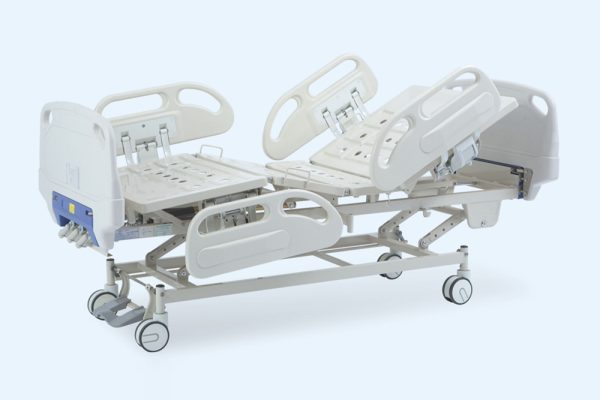
Manual adjustable hospital beds (FDA Class I, 21 CFR 880.5120) are operated by hand cranks to adjust backrest, knee rest, and overall height. Despite the proliferation of electric beds, manual beds continue to dominate general wards, long‑term care facilities, home healthcare, and low‑resource settings due to their inherent reliability, environmental robustness, and low total cost of ownership.
| Parameter | Manual Bed (All-Mechanical) | Electric Bed (Electromechanical) |
|---|---|---|
| Power dependency | None | Mains or battery |
| Environmental tolerance | −10°C to +50°C; high humidity | 5°C to 40°C; humidity <80% |
| Mean cycles between failure (MCBF) | >10,000 full load cycles | 3,000–5,000 cycles |
| Typical lifespan | 10–15 years | 7–10 years |
| Failure detection | Tactile (crank resistance change) | Error code or silent failure |
| Electromagnetic immunity | Complete | Susceptible |
Joyhann’s engineering position: Manual beds are not obsolete – they are optimised for high-reliability, low-service environments where clinical uptime is critical.
The number of independent crank mechanisms defines clinical capability.
| Crank Type | Alternative Name | Movements Controlled | Joyhann Model (Code) |
|---|---|---|---|
| Single | Single-swing | Backrest only (0–70°) | YEC2-1 (012103) – paediatric |
| Double | Double-swing | Backrest (0–70°) + Knee/leg (0–45°) | BC36-4 (012843), BC311-4 (012829) |
| Triple | Triple-swing | Back + Knee + Overall height (500–750 mm) | BC46-4 (0128100 / 012849) |
Key dimensions (BC46-4):
Length 2170 mm | Width with rails 1260 mm | Integral lift 500–750 mm | Back angle 0–70° | Knee angle 0–45°
All manual crank systems use a sealed lead screw mechanism – typically an Acme thread stainless steel screw rotating inside a bronze or composite nut.
| Component | Material | Function |
|---|---|---|
| Crank handle | Chrome-plated steel or ABS | Input torque (foldable, under-bed storage) |
| Steel shaft | Carbon steel | Rotation transmission |
| Lead screw | Stainless steel (Acme thread) | Converts rotation to linear motion |
| Nut | Bronze or PEEK composite | Travels along screw, attached to lifting linkage |
| Lifting arm | Steel scissor or lever | Raises/lowers bed section |
Why lead screws for manual beds:
| Crank Type | Primary Indication | Nursing Benefit | Patient Outcome |
|---|---|---|---|
| Single | Short-stay, observation, paediatric | Minimal training | Head elevation for breathing/feeding |
| Double | General surgery, post-op, medical wards | Prevents patient sliding; reduces sacral pressure | Lower pressure injury risk (sacrum/heel) |
| Triple | Geriatrics, LTC, rehab, bariatric | Ergonomic height for caregivers; easy transfer | Fewer falls; less back strain |
Clinical guideline: Repositioning every 2–3 hours is standard for pressure ulcer prevention. Triple-crank beds make this physically sustainable for nursing teams.
Every component is engineered for strength, durability, and cleanability.
| Component | Material | Manufacturing Process | Quality Control |
|---|---|---|---|
| Main frame | Carbon steel tube | Robotic plasma welding | Minimal HAZ; X-ray spot check |
| Lead screw assembly | Stainless steel + bronze nut | CNC turning + precision lapping | 0.1 mm positional tolerance |
| Crank handle | Chrome steel or ABS | Die casting + polishing | 360° fold, non-slip |
| Head/foot panels | ABS | Injection molding (CNC molds) | Flash-free edges |
| Side rails | ABS + steel core | Over-molding | Smooth, no crevices |
| Casters | Polyurethane + nylon | Injection + assembly | Brake test: 10,000 cycles |
| Powder coating | Epoxy | Electrostatic spray + 180°C cure | Cross-cut adhesion, 100 µm |
Joyhann’s advanced processes (catalog references):
Infection control is not an add‑on – it is engineered into every manufacturing choice.
| Manufacturing Feature | Infection Control Benefit |
|---|---|
| Robotic welding + minimal weld seams | Eliminates crevices that trap biofilm |
| Flash-free ABS molding | No rough edges to retain organic matter |
| Seamless epoxy powder coating | Resists chemical disinfectants; no exposed steel |
| Detachable ABS head/foot panels | Complete access for terminal cleaning |
| Smooth, non-porous surfaces | Pathogens do not adhere; easy wipe-down |
| Removable crank handles | Can be cleaned separately or autoclaved |
CDC alignment: “Environmental surfaces must be effectively cleaned and disinfected.” Joyhann beds have no hidden crevices and all surfaces are compatible with hypochlorite and quaternary ammonium compounds.
Beyond basic cleanability, advanced materials actively reduce bioburden.
| Material / Technology | Property | Clinical Evidence |
|---|---|---|
| ABS (base) | Non-porous, impact-resistant | Withstands daily hypochlorite wiping |
| Chlorhexidine-coated ABS | Kills microbes on contact | Eliminates SARS-CoV-2 within 30 min (Univ. Nottingham, 2024) |
| Silver nanoparticle-infused surfaces | Disrupts bacterial enzyme systems | Reduces biofilm formation (ISO 22196) |
| Copper alloys | Broad-spectrum antimicrobial | EPA-registered, self-sanitising every 2 hours |
| Epoxy powder coating (smooth) | No micro-cracks for biofilm | Outperforms liquid paint in accelerated aging |
Joyhann standard: High-impact ABS that withstands repeated disinfection. Antimicrobial coatings available on request for high-risk units (ICU, burns).
Since 2023, the FDA has recognised IEC 60601‑2‑52 as the key standard for medical beds. It covers mechanical strength, stability, and entrapment.
Seven entrapment zones (FDA guidance):
| Zone | Location | Primary Risk |
|---|---|---|
| 1 | Within rail opening | Head/neck entrapment |
| 2 | Between rail and mattress | Chest compression |
| 3 | Between rail and bed frame | Limb entrapment |
| 4 | Under rail / between mattress and footboard | Body migration |
| 5 | Between split rails | Finger/hand injury |
| 6 | Between bed frame and casters | Foreign object / debris |
| 7 | Between headboard and mattress edge | Head entrapment |
Compliant manual beds maintain rail-to-mattress gaps ≤ 120 mm (adult) and use fixed corner guards. Joyhann beds are designed to comply with IEC 60601-2-52 – full documentation available.
Based directly on the Joyhann product catalog (pages 11–18, 21–24, 28–30).
| Department | Recommended Model | Crank Type | Product Code | Key Feature |
|---|---|---|---|---|
| General Surgery | BC36-4 | Double | 012843 | Back + knee elevation |
| Medical Ward | BC311-4 | Double | 012829 | ABS panels, central brake |
| Geriatric / LTC | BC46-4 | Triple | 0128100 | Integral lift 500–750 mm |
| Orthopedic / Traction | QYC21-V | Double + traction frame | 0128200 | Removable head/foot panels |
| Paediatric | YEC2-1 | Single (crib) | 012103 | Transparent acrylic sides |
| Newborn Nursery | YEC2-2 | Single (baby bed) | 012104 | Mesh sides |
| Delivery / OB | CC2-1 | Manual lithotomy | 012601 | Leg rests, Trendelenburg |
| Emergency / Transport | TC1-1 (rescue) | Hydraulic push (no crank) | 012712B | Full Trendelenburg, 590–920 mm lift |
Procurement tip: For mixed wards, standardising on BC311-4 (double crank) with removable ABS headboards covers >80% of patient needs.
A manual bed never functions alone. Joyhann includes a full ecosystem of supporting products that maintain infection control and clinical efficiency.
Bedside cabinets provide secure medication storage, a clean work surface for nursing procedures, and organised compartments for patient belongings. They must be constructed with the same cleanability standards as the bed itself.
| Model | Code | Dimensions (mm) | Primary Use | Cleanability Feature |
|---|---|---|---|---|
| YPG4-2 (Medicine cabinet) | 010203 | 1000 × 500 × 2000 | Locked medication storage | Powder-coated steel, smooth surfaces |
| YPG4-3 (Medicine cabinet) | 010204 | 1000 × 580 × 2000 | Larger capacity | Same coating; crevice-free design |
| DMG1-1 (CR medicine cabinet) | 013601 | 960 × 400 × 1750 | Step-type, compact footprint | ABS components available |
| CR Medicine Cabinet | 010201 | 960 × 400 × 1750 | Stepped shelf design | Electrostatic epoxy finish |
Infection control link: The same powder-coated steel and smooth ABS surfaces used on Joyhann beds are applied to bedside cabinets, ensuring no cross-contamination risk between bed and cabinet. Cabinets should be wiped daily with EPA-registered disinfectants (hypochlorite 500 ppm or QAC 400 ppm).
Joyhann beds (e.g., BC46‑4, BC36‑4) include integrated curtain rail hooks or dedicated mounting points. While curtains are not supplied by Joyhann, the bed geometry accepts standard hospital cubicle curtain tracks. This enables spatial infection isolation between beds – a key CDC recommendation for reducing airborne and contact transmission.
Curtain specifications for compatibility:
Family members staying overnight require rest facilities. Joyhann does not manufacture dedicated sleeper chairs, but provides dimensional drawings to coordinate with third‑party furniture. The BC46‑4 offers 500 mm clearance under the bed when raised to its highest position (750 mm), allowing a folded attendant bed (typical folded height 250–300 mm) to slide underneath during the day.
For facilities that prefer an integrated solution, Joyhann recommends the following third‑party compatibility criteria:
A hospital bed’s long‑term performance depends on its underlying engineering architecture.
| Technical Parameter | Manual Bed (Mechanical) | Electric Bed (Electromechanical) |
|---|---|---|
| Primary actuation | Sealed lead screw (Acme thread, bronze nut) | DC linear actuator + motor + encoder |
| Mean cycles between failure (MCBF) | >10,000 full load cycles | 3,000–5,000 cycles |
| Critical failure modes | Nut thread wear; caster brake creep | Motor burnout, PCB corrosion, wiring fatigue, encoder drift |
| Failure detection | Tactile (crank resistance change) + audible | Error code or silent failure |
| Mean time to repair (MTTR) | 15–30 min (in-situ) | 2–4 hours (off-bed repair) |
| Wet/dry cleaning compatibility | Fully sealed; IPX4–IPX6 possible | Low IP rating; moisture ingress common |
| EMI immunity | Complete | Susceptible |
| End-of-life recyclability | >90% (steel, brass, ABS) | Mixed materials, lower recyclability |
Engineering conclusion: For high-reliability, low-service environments with uncertain power or moisture exposure, the all-mechanical architecture of a manual bed provides superior lifecycle robustness.
Manual bed manufacturing is undergoing continuous technical evolution.
| Technology Area | 2025 Baseline | 2034 Direction | Engineering Benefit |
|---|---|---|---|
| Frame welding | Manual MIG + post-grind | Robotic plasma welding (seam tracking) | Zero-porosity joints; no stress risers |
| Lead screw materials | Stainless steel + sintered bronze | Polymer-coated steel + PEEK nut | 2× wear life; no external lubrication |
| ABS panel manufacturing | Conventional injection molding | Gas-assisted injection + antimicrobial masterbatch | Uniform wall thickness; integrated microbial reduction |
| Powder coating | Epoxy polyester (60–80 µm) | Super-durable polyurethane hybrid (100–120 µm) | 5× abrasion resistance; tolerant to sporicides |
| Caster brake design | Cam-over-center | Sealed dual-stage stainless ratchet | 20,000 cycle durability; failsafe engagement |
| Modular architecture | Bed-specific parts | Platform-based common components | Reduced spare part SKU; lower supply chain complexity |
| Regulatory validation | Physical testing only | Simulation-assisted (FEA + spot check) | Faster iteration; validated entrapment zones |
By 2034, manual beds will feature PEEK lead screw nuts, integrated antimicrobial surfaces (ISO 22196 >99.9% reduction), and robotic welding for flawless frame integrity.
Joyhann offers a suite of engineering‑focused support services for hospital project teams, facility managers, and clinical engineers – provided free of charge as part of technical collaboration.
| Service | Technical Content | Deliverable |
|---|---|---|
| Ward engineering mapping | Structural load analysis; optimal bed placement for cleaning access and entrapment compliance | CAD layout with bed positions, cleaning radius, clearances |
| Lead screw fatigue life calculation | Based on expected daily articulation cycles (back/knee/height) | Cycle-based maintenance schedule (e.g., “inspect nut after 8,000 cycles”) |
| Infection control surface compatibility testing | Test your disinfectants (hypochlorite, QAC, peracetic acid) against our materials | Material compatibility chart; maximum exposure time |
| Caster floor compatibility assessment | Analysis of floor type and rolling resistance/brake holding force | Recommended caster durometer and tread pattern |
| Regulatory documentation package | Full IEC 60601-2-52 compliance file (gap measurements, entrapment validation, structural tests) | PDF dossier for local health authority submission |
| Remote engineering support | Video-guided troubleshooting; AI-assisted spare part identification | 2-hour response (Asia-Pacific) / 4-hour (global) |
How to access: Submit a technical request form via info@joyhann.com specifying your project phase (design, procurement, installation, or maintenance). Joyhann’s engineering team will assign a dedicated technical account manager.
Service commitment: Provided under ISO 9001:2015 and ISO 13485:2016. Technical documentation maintained with full version traceability.
Manual hospital beds are not a budget compromise – they are a technically sophisticated, highly reliable class of medical devices. Understanding crank classification, lead screw mechanics, precision manufacturing processes, and infection control integration enables evidence‑based procurement that reduces HAI risk, improves nursing ergonomics, and ensures decades of dependable service.
Joyhann’s manual bed portfolio – from the BC46‑4 triple‑crank for geriatric care to the BC311‑4 double‑crank for general wards – is built on robotic welding, antimicrobial‑compatible ABS, and full IEC 60601‑2‑52 compliance. When paired with Joyhann’s bedside cabinets (YPG4‑2, YPG4‑3, DMG1‑1), the complete patient environment supports both clinical outcomes and environmental hygiene.
For clinical engineers and facility managers, the choice is clear: manual beds, when engineered correctly, are a first‑line strategic asset – not a fallback.

Joyhann‘s integrated belt conveyor–autoclave–shredder systems provide healthcare facilities with a complete, turnkey solution—engineered for safety, designed for reliability, and verified to produce no dioxins. From small community hospitals to large tertiary centers, tiered configurations are available to match actual waste generation patterns.
Subscribe to receive exclusive insights and priority updates from Joyhann. Elevate your practice with our curated intelligence.
© Nortek HealthCare Group Ltd., 2009-2026. All rights reserved.
This site operates under the laws of the People's Republic of China. Your access and use constitute acceptance of these Terms of Use and our Privacy Policy. All content is governed by our Privacy Notice. For details or inquiries, please Contact Us or use the site's search function.