CSSD Workflow & Infrastructure Rollout

Joyhann presents a structured, step‑by‑step approach to designing and equipping a high‑performance Central Sterile Supply Department (CSSD). Our platform integrates advanced medical devices, ergonomic infrastructure, and validated protocols into a seamless workflow. Each step is engineered to eliminate cross‑contamination, optimize throughput, and provide complete traceability—from soiled instrument reception to sterile storage.The following steps represent the logical progression of instrument reprocessing. Every Joyhann product is embedded within this flow, not as standalone equipment, but as a critical component of an integrated system.
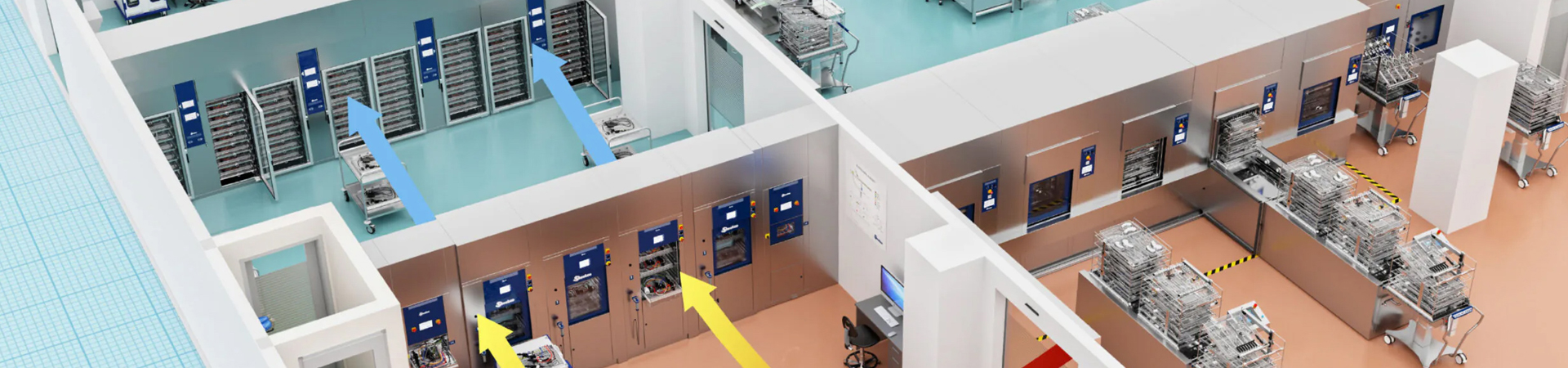
  • Step #1
  • Step #2
  • Step #3
  • Step #4
  • Step #5
  • Step #6
Contaminated Reception & Automated Pre‑Cleaning

Objective: Immediately reduce bioburden and prepare instruments for mechanical washing, preventing organic matter from drying onto surfaces.


Upon entry into the contaminated zone, instruments are sorted and placed into the Ultrasound Cleaning System. This device uses high‑frequency cavitation (35–45 kHz) to generate microscopic bubbles that implode on instrument surfaces, dislodging proteinaceous debris from hinges, lumens, and serrations. The process achieves a ≥4 log reduction in bioburden before automated washing, which is critical for subsequent disinfection efficacy.


  • Ultrasound Cleaning System: Multi‑frequency transducers ensure uniform energy distribution; programmable cycles (5–15 min) with integrated heating (up to 60°C) enhance detergent activity. Basket configurations accommodate trays, microsurgical instruments, and delicate optics.


  • Workflow Integration: Positioned adjacent to the Washer‑Disinfector loading station, the ultrasound unit creates a continuous pre‑treatment step. Operators transfer baskets directly without manual handling, reducing contamination risk.


Technical note: The system includes automatic degassing to optimize cavitation and a self‑cleaning mode to prevent cross‑load carryover.

Automated Washing & Thermal Disinfection

Objective: Achieve validated cleanliness and thermal disinfection (A0 ≥ 3000) in a fully automated, reproducible process.


Pre‑cleaned instruments are loaded into the Washer‑Disinfector—a pass‑through design that enforces unidirectional flow. Programmable cycles comply with ISO 15883, incorporating multiple phases: pre‑rinse, enzymatic wash (with temperature‑controlled detergent injection), intermediate rinse, thermal disinfection (hold at 90°C for 5 minutes, achieving A0 ≥ 3000), and final demineralized water rinse to prevent spotting.


  • Washer‑Disinfector: Chamber volumes from 1 to 20 baskets; rotary spray arms with redundant coverage; integrated conductivity monitoring for rinse water quality; data logging of each cycle (temperature, pressure, A0 value) for batch traceability.


  • Drying Cabinet: Immediately after washing, instruments enter the adjacent Drying Cabinet. HEPA‑filtered air (ISO Class 5) is circulated at 70–110°C with programmable drying times (15–60 min). Real‑time humidity sensors ensure complete dryness before inspection—critical for preventing corrosion and ensuring sterilant penetration.


Technical note: The cabinet features double‑glazed doors for visual monitoring and adjustable shelving to accommodate tall instrument sets.

Inspection, Assembly & Sterile Barrier Packaging

Objective: Verify cleanliness, assemble instrument sets, and create a validated sterile barrier system.


In a positive‑pressure clean zone (ISO Class 7 or better), staff work at CSSD Furniture—modular stainless‑steel workstations with integrated LED lighting, magnifying lamps, and ergonomic height adjustment. Surfaces are seamless and coved to prevent biofilm accumulation. Drawers and shelving are organized for efficient storage of wraps, pouches, and chemical indicators.


  • CSSD Furniture: Workstations with built‑in utility panels (compressed air, vacuum); sink modules with gooseneck faucets; under‑counter storage for detergents and consumables. All materials are 304 stainless steel, resistant to corrosion and cleaning agents.


  • Heat Sealer: For sterile barrier systems, the impulse sealer provides parametric control of temperature (150–200°C), pressure, and dwell time (0.5–3.0 s). Seal width is consistently ≥6 mm per EN 868‑5. Integrated printers record cycle parameters, and validation ports allow for routine seal strength testing.


  • Sterilization Bag & Wrap: A complete range of medical‑grade packaging:


    • Self‑seal pouches (paper/plastic) with internal chemical indicators.
    • Heat‑seal reels for custom‑length packaging.
      Non‑woven SMS wraps (spunbond‑meltblown‑spunbond) with bacterial filtration efficiency >99.9%, available in dual‑layer configurations for heavy sets.
    • Lot‑tracked materials ensure traceability to raw material batches.


Technical note: Workflow is optimized by positioning heat sealers and packaging supplies at arm’s length from inspection areas, minimizing movement and potential contamination.

Terminal Sterilization – Modality‑Specific Solutions

Objective: Achieve sterility assurance level (SAL) of 10⁻⁶ using the appropriate technology for each load type.


Joyhann offers three complementary sterilizers, allowing the CSSD to match the sterilization method to instrument compatibility and clinical requirements. Units are arranged in a dedicated sterilization zone with pass‑through walls to separate clean and sterile sides.


Pulse Vacuum Steam Sterilizer

For heat‑ and moisture‑stable instruments, textiles, and porous loads.


  • Technology: Fractional pre‑vacuum pulses (three cycles down to 0.2 bar absolute) remove air from complex geometries. Chamber constructed from 316L stainless steel with electrophished surfaces for corrosion resistance.


  • Cycle Parameters: Sterilization at 121–134°C; holding times adjustable per load (e.g., 3 min for wrapped instruments, 18 min for textiles). Integrated data logger records temperature, pressure, and time at the reference probe.


  • Validation: Routine Bowie‑Dick tests detect non‑condensable gases; biological indicators (Geobacillus stearothermophilus) confirm lethality.


H₂O₂ Plasma Sterilizer

For heat‑ and moisture‑sensitive devices: endoscopes, cameras, powered instruments, and some plastics.


  • Technology: Low‑temperature (≤55°C) process using hydrogen peroxide vapor followed by plasma phase. The vapor is uniformly distributed via injection nozzles; plasma dissociates residual peroxide into water and oxygen, leaving no toxic residues.


  • Cycle Duration: Typical cycles 28–55 min depending on load configuration. Chamber volumes from 50 L to 200 L.


  • Compatibility: Validated for a wide range of materials; built‑in vapor‑injection system adapts to load configuration for optimal diffusion.


EtO Sterilizer

For complex, lumen‑rich devices requiring terminal sterilization where heat or moisture is prohibitive.


  • Technology: Precise control of ethylene oxide concentration (450–1200 mg/L), humidity (40–80% RH), temperature (37–55°C), and exposure time. Post‑cycle aeration phases reduce residual EtO to below ISO 10993‑7 limits.


  • Chamber Sizes: 150 L to 800 L, accommodating full instrument trays or multiple sets.


  • Safety: Integrated catalytic converter for exhaust gas treatment; continuous leak monitoring.


Technical note: All sterilizers feature barcode scanners to automatically record load contents, operator ID, and cycle parameters, feeding into a centralized CSSD management system for full traceability.

Sterile Storage & Internal Logistics

Objective: Protect sterilized goods from contamination and damage during storage and transport to point of use.


After sterilization (and cooling, for steam‑processed items), sterile packs are transferred to the sterile storage zone. Joyhann provides:


  • Transport & Storage Carts: Closed, stainless‑steel carts with smooth surfaces and locking mechanisms. Designed to protect sterile packs from dust, impact, and moisture during internal transit. Shelves are adjustable and accommodate standard CSSD trays. Silent casters with directional locks ensure easy maneuverability.


  • Sterile Storage Shelving: Modular, epoxy‑coated wire shelving that promotes air circulation and is easily cleanable. Barcode or RFID compatibility is integrated for inventory management, ensuring FIFO (first‑in, first‑out) rotation.


  • Transport Containers: Perforated or solid bottom containers for organized transport of sets to operating rooms.


Technical note: Carts are designed to interface seamlessly with sterilizer unloading platforms, reducing handling and potential contamination events.

Process Validation & Quality Assurance

Objective: Provide the tools and protocols to verify that every step consistently meets defined specifications.


Sterility assurance depends on rigorous, routine validation. Joyhann embeds a comprehensive validation framework into the infrastructure:


  • Biological Indicators (BIs): Geobacillus stearothermophilus spores for steam and H₂O₂ (≥10⁶ per carrier); Bacillus atrophaeus for EtO. Incubators with automated readers deliver results within 24 hours, with digital records linking each BI to the specific load.


  • Chemical Indicators: Class 4 multi‑variable indicators and class 5 integrating indicators that respond to all critical parameters (time, temperature, sterilant concentration). Bowie‑Dick sheets for daily steam sterilizer testing.


  • Process Challenge Devices (PCDs): Simulate the most difficult‑to‑sterilize items. For steam, hollow load PCDs with defined lumen dimensions; for H₂O₂, helical PCDs that challenge vapor diffusion.


  • Physical Measurement: Calibrated thermocouples, pressure transducers, and humidity sensors for IQ/OQ/PQ (Installation/Operational/Performance Qualification). Joyhann’s service team supports on‑site validation and trains staff in statistical process control.


Technical note: All validation data can be exported to hospital information systems, supporting accreditation surveys and continuous improvement.

Communications from Joyhann

Subscribe to receive exclusive insights and priority updates from Joyhann. Elevate your practice with our curated intelligence.